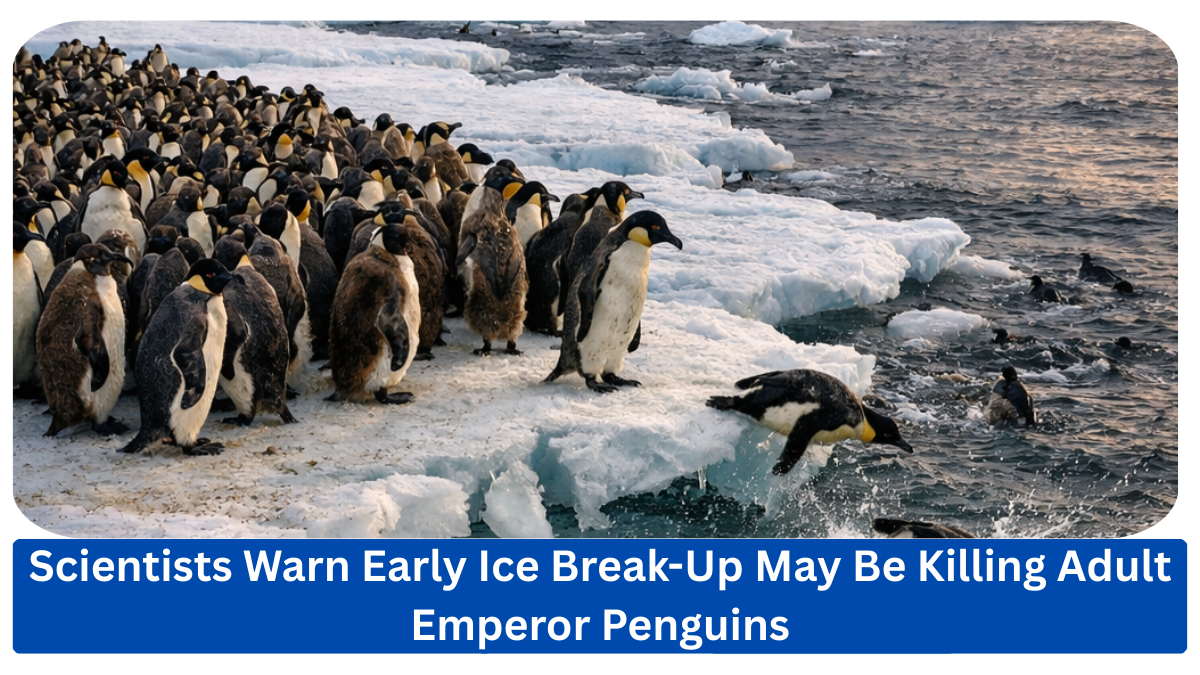
Satellite observations have revealed previously unknown moulting colonies of emperor penguins in Antarctica, but rapidly shrinking sea ice is pushing the birds into crowded fast-ice refuges. Early seasonal ice break-up may already have caused substantial adult deaths, intensifying concerns about the species’ long-term survival.
Scientists studying satellite images across Antarctica have identified previously undocumented moulting locations for emperor penguins, a finding that both expands scientific knowledge and heightens concern about the birds’ future.
Researchers from the British Antarctic Survey made the discovery unexpectedly after noticing unusual brown discoloration along the isolated coastline of Marie Byrd Land. The observation coincided with the penguins’ annual moulting season, prompting a closer examination.
Until now, little has been understood about where emperor penguins travel to moult, the essential yearly stage when worn feathers are replaced with new waterproof plumage. This research represents the first instance in which satellite imagery has been used to pinpoint moulting colonies, providing rare insight into one of the most vulnerable periods in the penguins’ life cycle.
However, the satellite data also highlighted an escalating danger.
Each austral summer, emperor penguins from the Ross Sea in West Antarctica travel distances of up to 1,000 km to reach Marie Byrd Land, searching for stable fast ice, sea ice attached to the shoreline, where they can complete their moult. The seven breeding colonies that move to this region account for as much as 40% of the global population.
Moulting is among the most hazardous stages of an emperor penguin’s life. For several weeks, the birds cannot enter the water to feed and must remain on secure ice while their new feathers develop. If they are forced into the sea too early, before their plumage regains full waterproof protection, they face risks including hypothermia, higher energy loss, and greater exposure to predators.
Historically, Marie Byrd Land has been one of the few places where fast ice persists throughout the year. Yet analysis covering seven years of satellite records identified more than 100 moulting groups along the coastline and revealed a marked behavioural change during years with reduced ice.
As sea ice declined, penguins were pushed onto progressively smaller fast-ice areas, resulting in denser and increasingly crowded groupings.
From 2022 to 2024, Antarctic sea-ice coverage dropped to record lows, with fast-ice levels falling sharply. In the study region, total coverage collapsed from a 50-year average of about 500,000 km² — roughly equivalent to Spain, to only 100,000 km² in 2023. Of that, merely 2,000 km² was coastal fast ice.
In several of those seasons, the ice broke apart before the penguins had finished moulting.
By 2025, satellite imagery showed only 25 small moulting groups remaining in the region, a steep reduction from the more than 100 groups recorded before 2022. The causes are still unclear. The birds may have moved to moulting locations that have not yet been identified, or the population could have experienced major losses.
For a long-lived species capable of surviving up to 20 years and beginning reproduction only between ages three and six, adult mortality poses a much greater long-term threat than breeding failure alone.
Dr Peter Fretwell, lead author and mapping specialist at the British Antarctic Survey, said:
“Emperor penguins already faced myriad threats, and the loss of moulting sites is yet another pressure. While we don’t know for sure what happened to those penguins, we know they can find new suitable breeding sites after ice loss, so it’s possible they have established new moulting sites elsewhere.
“But also it’s possible that huge numbers of penguins perished after entering the Southern Ocean before they had replaced their waterproof feathers. If this has happened, the situation for emperors as a species is even worse than we thought.”
Emperor penguins are widely considered a key indicator of the Antarctic marine ecosystem. The sea ice they rely on supports a complex food web that sustains seals, seabirds, and the extensive biological productivity beneath the ice, from krill to whales.
Unlike many Antarctic animals, emperor penguins can be tracked annually using satellite remote sensing, making them a particularly valuable measure of environmental change.
The newly identified moulting colonies therefore represent more than a scientific breakthrough. They also serve as a stark warning from a rapidly changing polar ice system, one that may signal wider, less visible disruptions unfolding across the Southern Ocean ecosystem.